
BACKGROUND

Beneath the waves, along the southern coastline of Australia, there is a reef that many people still do not know about.
It is called the Great Southern Reef.
The water here is cold, so unlike tropical reefs made of corals, the Great Southern Reef is built from rocky reefs covered in kelp. Kelp is a type of brown seaweed that forms large underwater forests, which are home to many marine creatures such as fish, molluscs and crustaceans.
Click on the image below to read and learn more about the Great Southern Reef
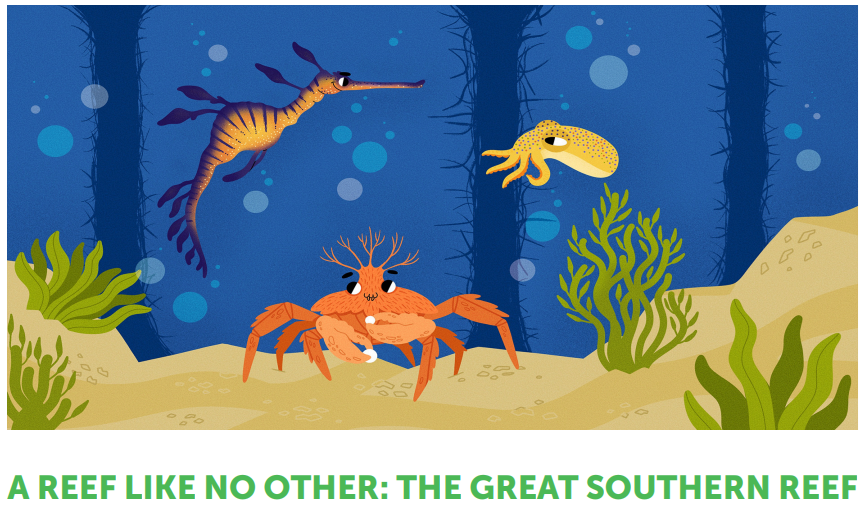
Freitas, C., O’Brien, M., Andrews, S., & Francis, P. (2023). A reef like no other: The Great Southern Reef. Frontiers for Young Minds 11(933489).
The document above has given you lots of helpful information about the kelp forests of the Great Southern Reef.
Try the quiz below and see what you’ve learned along the way
Quiz
What is a kelp forest?
A) An underwater habitat made by a brown seaweed, called kelp, that grow and cover large areas, forming underwater forests
B) A rainforest near the beach
C) A place where coral grows
Why are kelp forests important to the planet?
A) They help regulate the climate by absorbing carbon dioxide
B) They filter and clean the water and provide food and shelter for marine animals
C) All of the above
Why are kelp forests often forgotten or not talked about?
A) Because they grow underwater where people can’t easily see them
B) Because they only grow in other countries
C) Because they are too small to be noticed
Where is the Great Southern Reef located?
A) Along the southern coastline of Australia
B) In central Australia, far from the ocean
C) At the northern tip of Australia near the tropics
Why is the Great Southern Reef special?
A) It has plants and animals that are not found anywhere else in the world
B) It is made entirely of corals like the Great Barrier Reef
C) It is the same as all other reefs around the world
How fast can giant kelp grow?
A) Up to 50 cm per day
B) Up to 5 cm per week
C) It does not grow very fast
What does “endemic species” mean?
A) Species that migrate across the whole world
B) Species that live only in a specific geographic region.
C) Species that live on land and in water
What happens to kelp when the ocean becomes too warm for too long?
A) The kelp grow even faster
B) The kelp get sick and disappear
C) The kelp move to deeper parts of the ocean to find more sunlight
What does the seafloor look like after the kelp is gone?
A) Full of colourful sea plants and animals
B) Covered in coral and sea sponges
C) Bare and rocky, with little or no life
What is a simple action everyone can take to help keep Australia’s kelp forests?
A) Keep learning about the Great Southern Reef
B) Tell others that the Great Southern Reef is a real underwater treasure that needs protecting
C) All of the above