
BACKGROUND
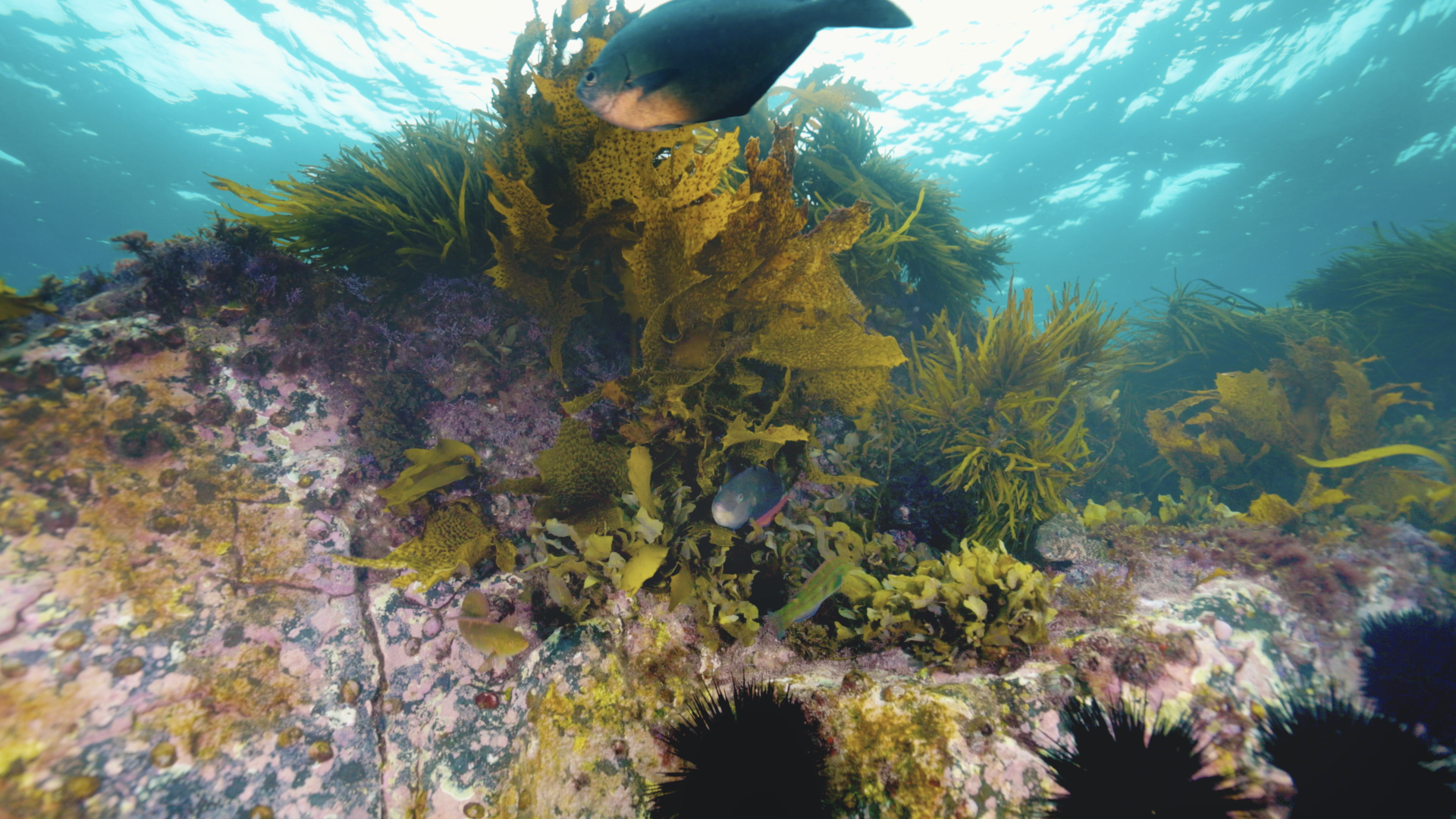
Here is a list of important words for this lesson
Adaptation: The adjustments of organisms to become better suited to survive and reproduce in an environment
Barren: A low productivity and low biodiversity area where sea urchins have eaten almost all the kelp and other seaweeds, leaving behind bare rocks.
Density: A measure of how much mass is present in a given volume. In biology, it can refer to the number of organisms in a particular space.
Echinoderm: a diverse group of marine organisms with radiating arrangement of parts and a body that may protrude as spines and including the sea stars, sea urchins, brittle stars, sea cucumbers, etc.
Biodiversity: The variety of life in a particular habitat or ecosystem, including different species of plants, animals, and microorganisms.
Climate change: Long-term shifts in weather patterns (e.g. temperature and rainfall).
Ecosystem: A community of living organisms interacting with each other and their physical environment.
Habitat: The natural environment in which a species lives and grows.
Invasive Species: Non-native organisms that spread rapidly in a new environment, often causing harm to native species and ecosystems.
Marine Protected Area (MPA): A region of the ocean designated for conservation and protection of natural resources, where human activities are regulated to preserve marine life.
Native: originating and naturally occurring in a specific area or environment.
Nutrient: a substance that an organism must obtain from its surroundings essential for maintenance of life and growth.
Population: a group of individuals of the same species that live within a given area at the same time.
Predator: an animal that hunts, kills, and consumes other animals, its prey, for food.
Prey: an animal that is hunted or killed by another animal, its predator, for food.
Overexploitation: refers to the excessive extraction and use of natural resources at a rate faster than their ability to regenerate, resulting in resource depletion.
Resilience: in an environmental context, it refers to the ability of an ecosystem to withstand and recover from disturbances and adapt to change, while preserving its essential functions and structure.
Roe: edible part of the sea urchin, specifically the animal’s gonads which produce its eggs.
Sea urchin: a marine invertebrate of the class Echinoidea with a soft body inside a hard shell covered in mobile spines, with a mouth on the underside.
Sustainable seafood: seafood that has been caught or farmed in a way that that protect the long-term health of species populations and ecosystems.
Species: a group of organisms that share common characteristics and can breed with each other.
Trophic Levels: The different levels in a food chain, based on the position an organism occupies, from producers (like plants) to consumers (like herbivores and predators).