
ADVOCATING FOR CHANGE

-
o Understand the purpose and process of social research in gathering community perspectives.
o Investigate public awareness of kelp forest restoration and sea urchin management.
o Develop skills in conducting, and interpreting survey-based social research.
o Explore how cost, effectiveness, and social values influence environmental decision-making.
o Communicate research findings using graphs, tables, and written explanations.
-
o Collect and organise survey responses systematically for analysis.
o Analyse survey data to identify patterns, trends, and community preferences regarding restoration strategies.
o Create visual representations (graphs and tables) to effectively communicate findings.
o Explain factors influencing community decision-making.
o Reflect on findings.
Social research helps us understand how people think, what they value, and how they make decisions. In this project, you will investigate how adults in the community feel about different ways to restore kelp forests affected by sea urchin overpopulation along Australia’s eastern coastline.
In this activity, you will run a short survey, analyse the results, and share what you learn with the class.
important Survey rules
The survey must be completed by adults only
All responses must be anonymous
Do not collect names, emails, or identifying details
If sharing online, use a secure link
If using paper surveys, provide a drop box at school for anonymous returns
Background context for participants
If no action is taken, Tasmania could lose up to 50% of its reef habitat by the 2030s.
To address this, scientists and governments are trialling different management strategies to reduce longspined sea urchin numbers and support kelp forest recovery.
Survey participants will be asked to review and respond to the following management options.
Management Plan Options
Marine Reserves EXTENSION

Marine reserves limit human activities to protect habitats and marine life. They support biodiversity, cultural values, research, and long-term ecosystem health.
Kelp Forest Restoration

Actively restoring kelp in damaged areas helps rebuild habitats, support marine species, and restore ecosystem balance.
Reintroduce rock lobsters
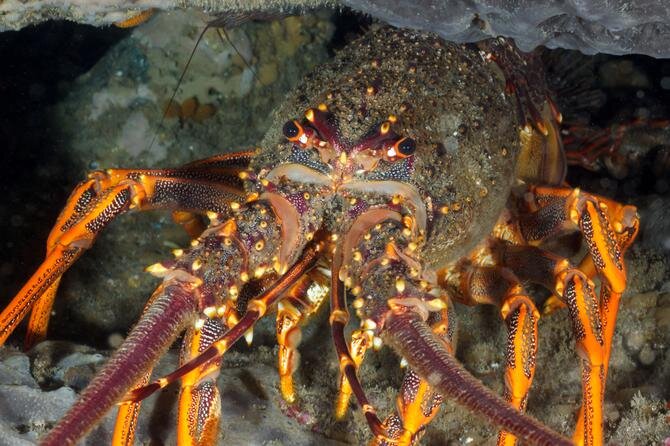
Rock lobsters are natural predators of sea urchins. Moving lobsters from stable populations to affected areas may help control urchin numbers and reduce kelp loss.
subsidise urchin harvest
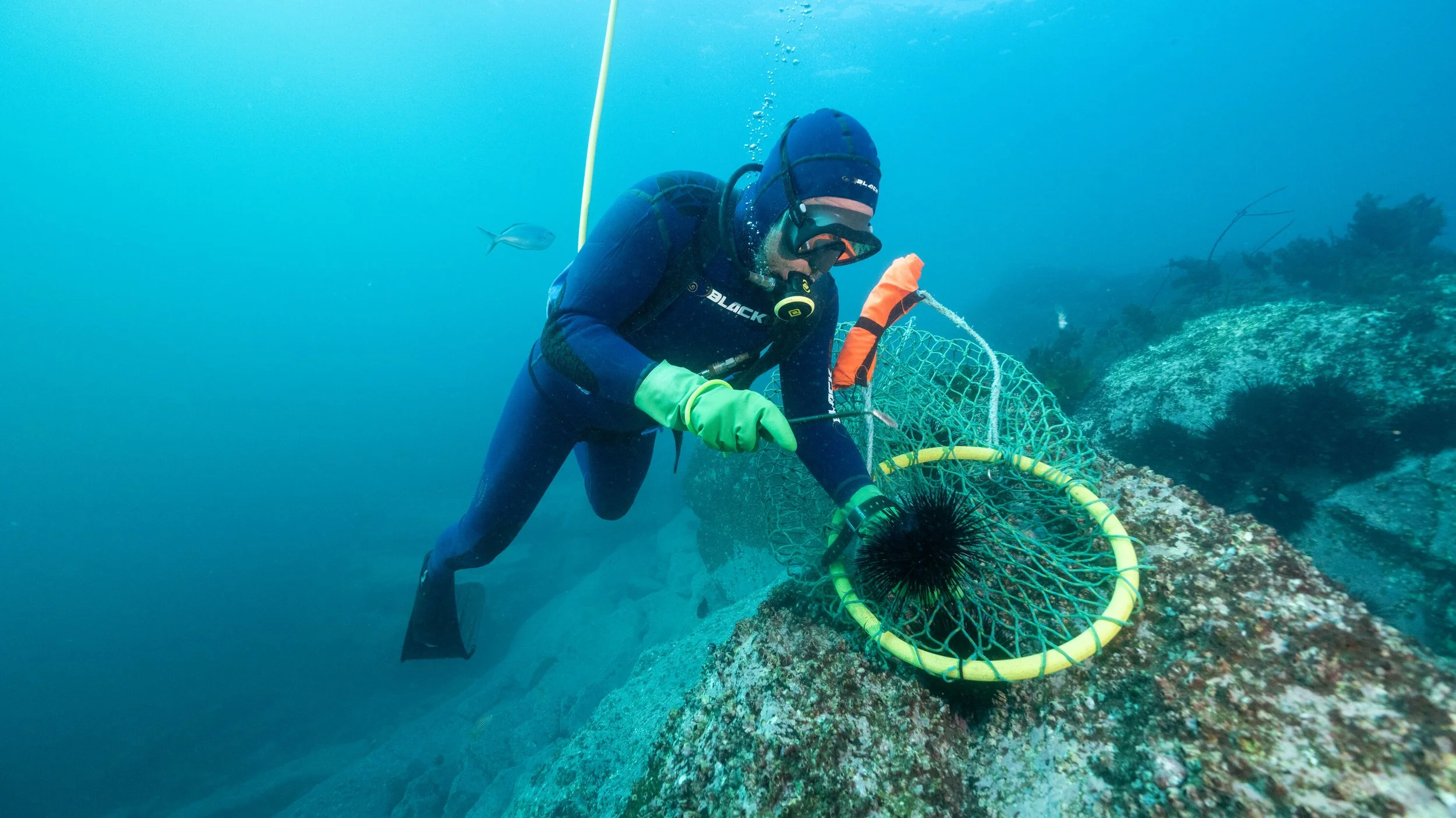
Supporting commercial harvesting of longspined sea urchins for roe creates jobs while reducing urchin numbers that damage kelp forests.
SURVEY
This survey is part of a high school research project that looks at how communities view different restoration options for kelp forests affected by the overpopulation of sea urchins along Australia’s eastern coastline. Your responses will remain anonymous and will be used for educational purposes only.
Q1: Did you know that longspined sea urchins, native to northern New South Wales, are spreading southwards to Victoria and Tasmania, destroying kelp forests and leaving barren sea floors?
☐ Yes
☐ No
If yes, what do you think caused this problem?
Q2: Please review the management plan options. Each option has a different cost. Please read the information carefully and choose one or more the options you would be willing to support through an increase in taxes per year, over a five-year period. This is a mock survey for a school project - no actual tax changes will happen, but please answer as if you really had to pay.
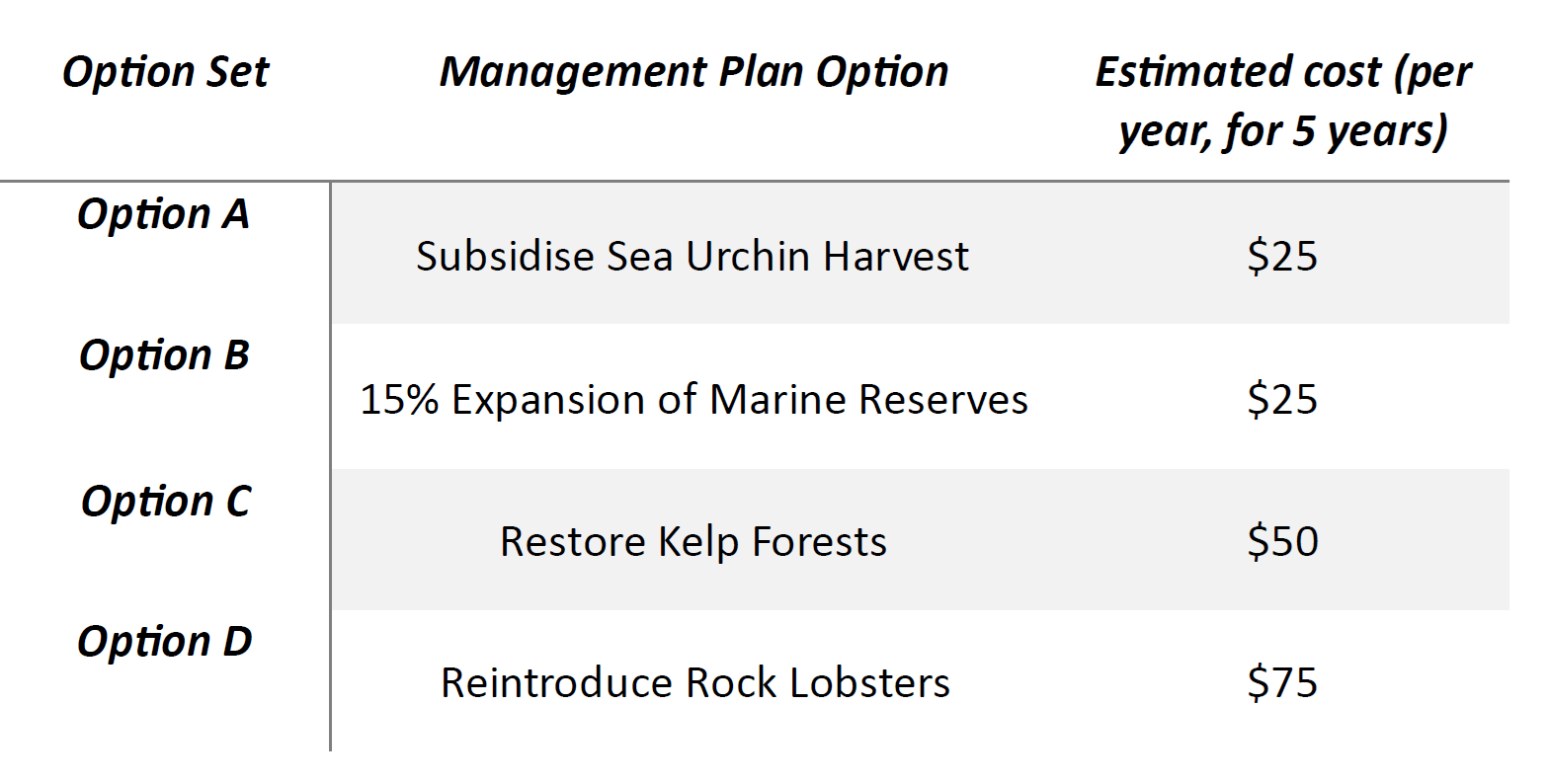
Option(s):
Q3: Please briefly explain the reasons for your chosen option

33. Analysing your results
Once all surveys are complete:
Collect all responses
Enter the data into a shared spreadsheet
Create graphs or tables to show patterns and trends
Discuss the results as a class, using the questions below
Discussion questions
Which options did people support the most? Why?
Why did some people choose lower-cost options?
What reasons may have influenced people who chose higher-cost options?
Did people who knew more about the issue choose different options?
If cost was removed, which option do you think would be most popular?
Would responses change if funding came from something other than taxes?
Were any results surprising?
What extra information might increase support for higher-cost options?
Note: This activity was developed based on and adapted from the study titled Investigating public preferences for the management of native and invasive species in the context of kelp restoration by Grover et al., 2021. While the restoration options, values, and information presented in this activity were inspired by the study, they have been modified for educational purposes and are not rigorously or directly linked to the original research.
Self Reflection: How am I going?
Think about today’s social research survey project. For each success criteria, choose a traffic light.
🟢 Confident · 🟡 Getting there · 🔴 Still working on it